
 Close Window
 Layout Return


REFLECTIONS
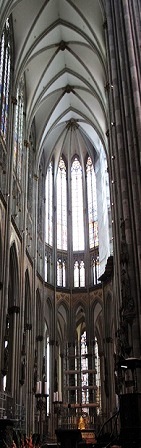 Main nave of the majestic Cologne Cathedral, Germany
GOOGLE TRANSLATE LAYOUT
Thirty Third Sunday of Ordinary Time (Year A)
First Reading
A reading from the Book of Proverbs (31:10-13, 19-20, 30-31)
When one finds worthy wife, her value is far beyond pearls. Her husband, entrusting his heart to her, has an unfailing prize. She brings him good, and not evil, all the days of her life. She obtains wool and flax and works with loving hands.
She puts her hands to the distaff, and her fingers ply the spindle. She reaches out her hands to the poor, and extends her arms to the needy. Charm is deceptive and beauty fleeting; the woman who fears the Lord is to be praised. Give her a reward for her labors, and let her works praise her at the city gates.
(P) The word of the Lord.(R) Thanks be to God.
Responsorial Psalm
Psalms of David (128:1-2, 3, 4-5)
(R) Blessed are those who fear the Lord.
Blessed are you who fear the Lord, who walk in His ways! For you shall eat the fruit of your handiwork; blessed shall you be, and favored. (R)
Your wife shall be like a fruitful vine in the recesses of your home; your children like olive plants around your table. (R)
Behold, thus is the man blessed who fears the Lord. The Lord bless you from Zion: may you see the prosperity of Jerusalem all the days of your life. (R)
Second Reading
A reading from the Letter of Saint Paul to the Thessalonians (5:1-6)
Concerning times and seasons, brothers and sisters, you have no need for anything to be written to you, for you yourselves know very well that the day of the Lord will come like a thief at night. When people are saying, "Peace and security," then sudden disaster comes upon them, like labor pains upon a pregnant woman, and they will not escape.
But you, brothers and sisters, are not in darkness, for that day to overtake you like a thief. For all of you are children of the light and children of the day. We are not of the night or of darkness. Therefore, let us not sleep as the rest do, but let us stay alert and sober.
(P) The word of the Lord.(R) Thanks be to God.
Gospel
A reading from the Gospel according to Matthew (25:14-30)
Jesus told his disciples this parable: "A man going on a journey called in his servants and entrusted his possessions to them. To one he gave five talents; to another, two; to a third, one - to each according to his ability. Then he went away."
"Immediately the one who received five talents went and traded with them, and made another five. Likewise, the one who received two made another two. But the man who received one went off and dug a hole in the ground and buried his master's money."
"After a long time the master of those servants came back and settled accounts with them. The one who had received five talents came forward bringing the additional five. He said, "Master, you gave me five talents. See, I have made five more." His master said to him, "Well done, my good and faithful servant. Since you were faithful in small maters, I will give you great responsibilities. Come, share your master's joy.""
"Then the one who received two talents also came forward and said, "Master, you gave me two talents. See, I have made two more." His master said to him, "Well done, my good and faithful servant. Since you were faithful in small matters, I will give you great responsibilities. Come and share your master's joy.""
"Then the one who received one talent came forward and said, "Master, I knew you were a demanding person, harvesting where you did not plant and gathering where you did not scatter; so out of fear I went off and buried your talent in the ground. Here it is back.""
"His master said to him in reply, "You wicked, lazy servant! So you knew that I harvest where I did not plant and gather where I did not scatter? Should you not then have put my money in the bank so that I could have got it back with interest on my return? Now then! Take the talent from him and give it to the one with ten. For to everyone who has, more will be given and he will grow rich; but from the one who has not, even what he has will be taken away. And throw this useless servant into the darkness outside, where there will be wailing and grinding of teeth.""
(P) The Gospel of the Lord.(R) Praise to you, Lord Jesus Christ.
Homily
Two men who meet again after many years are talking about their wives. One says proudly, "My wife is an angel." The other one says, "You're so lucky, mine is still alive."
Apparently angels are not just up in heaven. There are also angels among us. Here "angel" is used as a term of endearment, meaning someone who is a loving, kind, patient, gentle, caring, generous, trustworthy and calm. Today's first reading and psalm point out to us that only a small group of people that endear themselves to us that we can call "angels". They are the people who fear the Lord. The first reading from the Book of Proverbs for which Solomon was most likely the author says, "The woman who fears the Lord is to be praised." Psalm 128, which was written either by David or Solomon, says, "Blessed is the man who fears the Lord."
Fear the Lord! What does "Fear the Lord" mean? By definition, "fear is an emotional response which can be physical or mental or behavioral reaction to an actual threat". Is God a threat to us therefore we must fear Him? No. Fear of the Lord should not be understood as a mere dread. The Bible uses the Hebrew word for fear, yare, at least three hundred times in reference to God and, it carries a number of meanings. Most of the examples in the Bible show the fear of the Lord as something positive rather than negative. Fear of the Lord entails an emotional response of awe, wonder, love, trust, joy, respect, reverence and obedience. For example, in the Old Testament narrative of Joseph and his brothers, Joseph gains the trust of his brothers by declaring his fear of the Lord. He said to them, "Do this and you will live, for I am a man who fears God", Genesis (42:18). His declaration was meant to assure his brothers that he would not do either an unjust or cruel thing for he feared the Lord. In the Book of Exodus, (1:16-18), there is a story of the Egyptian King commanding the Hebrew midwives to kill all the baby boys but the midwives refused to follow the order of the king. They allowed the boys to live because they were God-fearing women. That's to say, the Hebrew women did not want to hurt or harm their neighbors because they feared and loved God. There is also another example in the Book of Exodus, (18:19-23). Upon the advice of his father-in-law, Jethro, Moses appointed God fearing men who can be trusted and who cannot be bribed, as leaders and judges of small communities. The Book of Leviticus, (19:14-32), narrates how the Israelites were urged to treat the disabled and the elderly well for the fear of God.
Fear of God was not just the standard for Old Testament Israel but also for New Testament times. Jesus said, "Do not be afraid of those who kill the body but cannot kill the soul; fear Him rather who can destroy both body and soul in hell", Matthew (10:28). Saint Paul exhorted the Christian believers, 2 Corinthians (7:1), to cleanse themselves from all filthiness both of body and spirit in the fear of God.
These examples show that to fear God is good because it makes us walk in obedience to the Lord. It saves us from giving into our sinful nature. It makes us hear no evil, see no evil and bring no evil upon others. It helps us keep our word and treat others with kindness. It does not make us flee from God but rather draw nearer to God. It helps us conquer the world. It instils in us a strong and steady sense of obligation. It brings us great blessings and rewards.
In today's narrative from the Book of Proverbs, Solomon reminds the husbands what the woman who fears the Lord has been bestowed with. Her fear of God makes her kind, compassionate, generous, sincere, hospitable, helpful, hardworking and a worthy wife for her husband. In other words, she is an angel not of charm or beauty which is fleeting but rather an angel of love and fidelity to her husband. However, the husband should contentedly and gratefully recognize her labors and faithfulness and, generously reward her in turn with his own love and fidelity because commitment between spouses is mutual. Moreover, the Psalm exhorts the husbands to fear the Lord and walk in God's ways so as to enjoy the fruits of the goodness of his wife and blessings of the Lord.
As a matter of fact, young and old, single and married, children, neighbors, kings and their subjects, employers and employees, businessmen, farmers, scholars - in a word everybody should fear the Lord, walk in His ways, love Him and serve Him. Friends, Saint Paul points out that the worst of sins is that we "have no fear of God at all", Romans (3:18). Those who do not fear God fear everything and everyone else and, are more likely to commit crimes and do evil. Today we have an opportunity to find out whether we truly fear God just as much as we truly love him or are we no better than nominal Christians who perform some external duties or participate in a few rituals.
(P) Amen.God Bless You!
Content Options
 share this homily via:

