
 Close Window
 Layout Return


REFLECTIONS
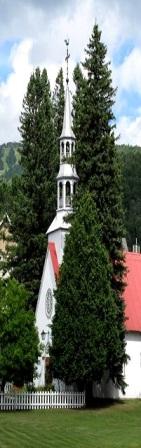 Chapel at the bottom of Mont Tremblant (875m), Province of Quebec, Canada
GOOGLE TRANSLATE LAYOUT
The Dedication of the Saint John Lateran Basilica (Year A)
First Reading
A reading from the Book of the Prophet Ezekiel (47:1-2, 8-9, 12)
The angel brought me back to the entrance of the temple, and I saw water flowing out from beneath the threshold of the temple toward the east, for the façade of the temple was toward the east; the water flowed down from the southern side of the temple, south of the altar. He led me outside by the north gate, and around to the outer gate facing the east, where I saw water trickling from the southern side. He said to me, "This water flows into the eastern district down upon the Arabah, and empties into the sea, the salt waters, which it makes fresh. Wherever the rive flows, every sort of living creature that can multiply shall live, and there shall be abundant fish, for wherever this water comes the sea shall be made fresh. Along both banks of the river, fruit trees of every kind shall grow; their leaves shall not fade, nor their fruit fail. Every month they shall bear fresh fruit, for they shall be watered by the flow from the sanctuary. Their fruit shall serve for food, and their leaves for medicine."
(P) The word of the Lord.(R) Thanks be to God.
Responsorial Psalm
Psalms of David (46:2-3, 5-6, 8-9)
(R) The waters of the river gladden the city of God, the holy dwelling of the Most High.
God is our refuge and our strength, an every-present help in distress. Therefore we fear not, though the Earth be shaken and mountains plunge into the depths of the sea. (R)
There is a stream whose runlets gladden the city of God, the holy dwelling of the Most High. God is in its midst; it shall not be disturbed; God will help it at the break of dawn. (R)
The Lord of hosts is with us; our stronghold is the God of Jacob. Come! Behold the deeds of the Lord, the astounding things He has wrought on Earth. (R)
Second Reading
A reading from the Letter of Saint Paul to the Corinthians (3:9c-11, 16-17)
Brothers and sisters: You are God's building. According to the grace of God given to me, like a wise master builder I laid a foundation, and another is building upon it. But each one must be careful how he builds upon it, for no one can lay a foundation other than the one that is there, namely, Jesus Christ.
Do you not know that you are the temple of God, and that the Spirit of God dwells in you? If anyone destroys God's temple, God will destroy that person; for the temple of God, which you are, is holy.
(P) The word of the Lord.(R) Thanks be to God.
Gospel
A reading from the Gospel according to John (2:13-22)
Since the Passover of the Jews was near, Jesus went up to Jerusalem. He found in the temple are those who sold oxen, sheep, and doves, as well as the money changers seated there. He made a whip out of cords and drove them all out of the temple area, with the sheep and oxen, and spilled the coins of the money changers and overturned their tables, and to those who sold doves he said, "Take these out of here, and stop making my father's house a marketplace." His disciples recalled the words of Scripture, zeal for your house will consume me. At this the Jews answered and said to him, "What sign can you show us for doing this?" Jesus answered and said to them, "Destroy this temple and in three days I will raise it up." The Jews said, "This temple has been under construction for forty-six years, and you will raise it up in three days?" But he was speaking about the temple of his body. Therefore, when he was raised from the dead, his disciples remembered that he had said this, and they came to believe the Scripture and the word Jesus had spoken.
(P) The Gospel of the Lord.(R) Praise to you, Lord Jesus Christ.
Homily
Learning or knowing our own history, or the history of our culture or the history of our faith, is important because it helps us to know who we are, where we came from and where we are going. As far as our Christian faith is concerned, celebrating a special day can also help us reconnect with the past, to better understand the basis for our belief and become aware of the continuity of our faith handed down from generation to generation. A celebration, such as today's feast of the dedication of the Saint John Lateran Basilica is therefore most earnestly recommended even though Sunday is widely observed as the Lord's Day and besides the feast is not as popular as other feasts. It may seem strange to many, as to why that we celebrate the dedication of a particular Church in Rome. For this, a little history is necessary.
The Latin word "basilica" comes from a Greek term basilike stoa meaning "royal house". Originally it referred to a Roman building used for public administration. But since the declaration of Christianity as the official religion of the Roman Empire in the early fourth century, a basilica has come to mean a church building that has been accorded special privileges by the Pope. There are two kinds of basilicas - major and minor. There are four ancient major basilicas, all of which are in Rome - Saint John Lateran, Saint Peter's of the Vatican, Saint Paul's outside the Wall, and Saint Mary Major, and more than 1580 minor basilicas around the world. The Pope grants the title "basilica" to some churches either to recognize their antiquity, dignity and historical importance or acknowledge their significance as centers of worship. Today the Church wants us to celebrate the Feast of the Dedication of the Saint John Lateran Basilica, just as we would with any local parish church.
Why is it being called John Lateran? Saint John Lateran stands on Esquiline Hill, one of the seven hills on which the ancient city of Rome was built. The name Lateran comes from a family named "Laterani" that owned a palace on the hill, which later on, was donated to Saint Melchiades, the pope at the time, who turned it into a church and residence for popes. Pope Sylvester who succeeded Pope Melchiades, dedicated the church to Saint John the Baptist and Saint John the Evangelist. Therefore the church is called the Saint John Lateran Basilica. Popes lived in the Lateran palace until the papal seat was transferred to Avignon, modern day France, in 1309, and then after the return of the Pope to Rome in 1377, he started to live at the Vatican and so did his successors.
Why is the Saint John Lateran Basilica important to our faith? What does the celebration have to do with our faith life? Since the Saint John Lateran Basilica was one of the first churches established by the Roman Emperor Constantine, it is considered the "Mother of all churches" or "The Cathedral of the Pope" or "The Cathedral Church of Rome", and the Pope is the Pastor of the Universal Church. As members of the Church we are all affiliated to our Mother Church and our Pastor, the Holy Father. Therefore, the Church seeks to remind us that we have received our faith in Jesus Christ through the apostles and the successors of the apostles and, we are saved not on our own but rather with the help of others in the church. That's why in the profession of faith after professing our faith in God the Father, the Son, and the Holy Spirit, we profess that we believe in the One, Holy, Catholic and Apostolic Church founded by Jesus Christ.
On June 25th, 2014 in his general audience address Pope Francis while speaking on the Church, reminded us that our Christian identity is one of belonging. He further elaborated that God chose a people in the Old Testament time and then in the fullness of time sent His only Son Jesus Christ to establish His Church to be the instrument for bestowing His blessings to all the people on Earth. Regardless of our differences in culture, race, language and status we are all part of the chosen people. Therefore, when someone says, "I am Christian", it means "I belong to the Church". The pope has also pointed out to us that we are not Christians, on our own or by ourselves but rather we are Christians because of others and with others. That's to say, we owe our faith in Jesus and our relationship with God not to ourselves but to the many people who have passed the faith on to us, who have led us to Baptism, taught us to pray, explained scriptures to us and showed us the way to a true Christian life. Finally the pope encourages us to see our relationship with God as something personal but not private. Hence, as disciples of Jesus we cannot disregard the Church. If someone says that he or she believes in God but does not want to belong to the church then there is a contradiction of faith.
However, belonging to or believing in the Church is not always easy, because often times we witness human weaknesses, limitations, failures and even scandals in the life of the Church. But despite these difficulties the pope tells us that God has called us to know Him and love Him precisely by being part of the sinful church, by remaining in the fellowship of the Church and by seeking in all things and above all, to grow in faith and holiness as members of the one body of Christ and by joyfully sharing it with others.
(P) Amen.God Bless You!
Content Options
 share this homily via:

