
 Close Window
 Layout Return


REFLECTIONS
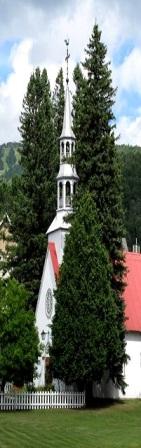 Chapel at the bottom of Mont Tremblant (875m), Province of Quebec, Canada
GOOGLE TRANSLATE LAYOUT
Twenty Third Sunday of Ordinary Time (Year C)
First Reading
A reading from the Book of Wisdom (9:13-18b)
Who can know God's counsel, or who can conceive what the Lord intends? For the deliberations of mortals are timid, and unsure are our plans. For the corruptible body burdens the soul and the earthen shelter weighs down the mind that has many concerns. And scarce do we guess the things on earth, and what is within our grasp we find with difficulty; but when things are in heaven, who can search them out? Or who ever knew your counsel, except you had given wisdom and sent your holy spirit from on high? And thus were the paths of those on earth made straight.
(P) The word of the Lord.(R) Thanks be to God.
Responsorial Psalm
Psalms of David (90:3-4, 5-6, 12-13, 14-17)
(R) In every age, O Lord, you have been our refuge.
You turn man back to dust, saying, "Return, O children of men." For a thousand years in your sight are as yesterday, now that it is past, or as a watch of the night. (R)
You make an end of them in their sleep; the next morning they are like the changing grass, which at dawn springs up anew, but by evening wilts and fades. (R)
Teach us to number our days aright, that we may gain wisdom of heart. Return, O Lord! How long? Have pity on your servants! (R)
Fill us at daybreak with your kindness, that we may shout for joy and gladness all our days. And may the gracious care of the lord our God be ours; prosper the work of our hands for us! Prosper the work of our hands! (R)
Second Reading
A reading from the Letter of Saint Paul to Philemon (9-10, 12-17)
I, Paul, an old man, and now also a prisoner for Christ Jesus, urge you on behalf of my child Onesimus, whose father I have become in my imprisonment; I am sending him, that is, my own heart, back to you. I should have liked to retain him for myself, so that he might serve me on your behalf in my imprisonment for the gospel, but I did not want to do anything without your consent, so that the good you do might not be forced but voluntary. Perhaps this is why he was away from you for a while, that you might have him back forever, no longer as a slave but more than a slave, a brother, beloved especially to me, but even more so to you, as a man and in the Lord. So if you regard me as a partner, welcome him as you would me.
(P) The word of the Lord.(R) Thanks be to God.
Gospel
A reading from the holy Gospel according to Luke (14:25-33)
Great crowds were traveling with Jesus, and he turned and addressed them, "If anyone comes to me without hating his father and mother, wife and children, brothers and sisters, and even his own life, he cannot be my disciple. Whoever does not carry his own cross and come after me cannot be my disciple. Which of you wishing to construct a tower does not first sit down and calculate the cost to see if there is enough for its completion? Otherwise, after laying the foundation and finding himself unable to finish the work the onlookers should laugh at him and say, "This one began to build but did not have the resources to finish." Or what king marching into battle would not first sit down and decide whether with ten thousand troops he can successfully oppose another king advancing upon him with twenty thousand troops? But if not, while he is still far away, he will send a delegation to ask for peace terms. In the same way, anyone of you who does not renounce all his possessions cannot be my disciple.
(P) The Gospel of the Lord.(R) Praise to you, Lord Jesus Christ.
Homily
While patrolling the streets a police officer sees two men fighting and a little boy standing alongside them crying, "Dad..., Dad...!" The officer pulls the two men apart and, turning to the boy, asks, "Which one is your father, boy?" Rubbing tears from his eyes, the boy says, I don't know. That's what they're fighting about."
In today's second reading Saint Paul acts as a spiritual father to bring reconciliation between two Christian brothers Philemon and Onesimus.
The New Testament in the Bible contains 14 letters/epistles attributed to Saint Paul. Some are addressed to new Christian communities or churches and others to individuals known personally to Paul. All of his letters help us not only to understand the life and times of the early Christians but also gives us a unique glimpse into the soul of the Apostle Paul. Particularly his personal letter to Philemon, with just twenty five verses, reveals the depth of his faith in Jesus Christ and the strength of his commitment. As for Paul, the grace of God is free to all but it does not come easy. It demands self-control, self-sacrifice and self-denial.
Paul is writing the letter while a prisoner in Rome. The letter is to a close friend and fellow believer, Philemon on behalf of a man called Onesimus. Philemon is a Christian slave owner who lives in an ancient city called Colossae in Turkey. He is a respected Christian leader who has been converted to Christ by Saint Paul and who uses his house for community worship and gathering. Onesimus, which in Greek literally means "useful", is a slave in Philemon's household. One day Onesimus after robbing his master, flees to Rome where he meets Paul. According to Roman law, a citizen had the duty to return a runaway slave to the owner. And the slave could be punished for his disloyalty with a brand on his arm, leg, or forehead or even be killed. A slave was granted freedom only as a reward for his work by the owner. And yet Paul decides to send Onesimus back to Philemon. He neither condemns slavery nor asks Philemon to free Onesimus which in fact any human rights activist would like to do. Friends, his letter to Philemon not only answers why he sends Onesimus back to his owner but also explains how he sends him.
Paul first guides Onesimus to become a believer in Christ and then sends him to Philemon so that true reconciliation between them is made possible. However, perceiving perhaps that such an approach could fail Paul takes the first and most important step to pursue peace. He humbly introduces himself, "I, Paul, an old man, and now a prisoner for Christ Jesus." Then he refers to Onesimus as his child and a bit of his own heart and, appeals to Philemon to receive Onesimus back into his household as he would receive Paul himself.
Moreover, he asks Philemon to accept him not as a slave but as a beloved brother. It must have been hard for Philemon to regard a runaway salve as a brother, but that is exactly what Paul demands. Paul does not directly address the slavery system but perhaps sows the seeds for the eradication of slavery among Christian believers by introducing a new relationship between a master and a servant, in which all external differences are abolished. Since the whole society is built upon the system he wants to change individuals first in order to bring a change in society.
What is the message for us?
- Many people believe that slavery no longer exists. But in fact there are many modern forms of slavery which affect people of all ages, gender and race. Bonded labor, child slavery, forced labor and human trafficking exist today despite the fact that they are illegal in all countries. Individuals, businesses, government agencies and non-government organizations on the one hand enact laws to prohibit slavery but on the other hand force people to work and fail to treat others justly and humanely. Even in families some are treated like slaves. Friends, we are called upon to put Jesus and his teaching first in our life. Let us rightly worship God, in and through Jesus, and live each day according to his teaching. Let us love God with all our heart, mind and soul and our neighbors as ourselves.
- We must understand the cost that comes from following Christ. Jesus unequivocally demands self-control, self-sacrifice and self-denial. In other words, for true reconciliation and peace we must be humble and willing to endure humiliation, pain and suffering.
- We must always welcome back people who hurt or offend us or do wrong. Often we tend to treat the people who offend us with suspicion. Sometimes we are not prepared to trust them again. We find it too difficult to forgive and accept them back. Christ demands that we truly repent, forgive the person and provide an opportunity for reconciliation and mend a broken relationship.
- We must use the special graces obtained in baptism and other sacraments to heal hurting hearts and bring the wounded people together and refresh them. For many hurting people, we can be their peacemakers/bridge builders. We can help people turn their life around by offering them friendship, forgiveness, and a hope-filled future.
God Bless You!
Content Options
 share this homily via:

