
 Close Window
 Layout Return


REFLECTIONS
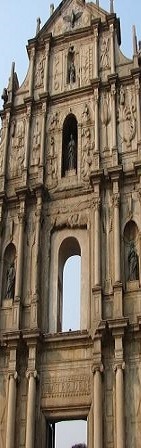 Ruin of Saint Paul's church facade in Macau, China
GOOGLE TRANSLATE LAYOUT
Nineteenth Sunday of Ordinary Time (Year C)
First Reading
A reading from the Book of Wisdom (18:6-9)
The night of the passover was known beforehand to our fathers, that, with sure knowledge of the oaths in which they put their faith, they might have courage. Your people awaited the salvation of the just and the destruction of their foes. For when you punished our adversaries, in this you glorified us whom you had summoned. For in secret the holy children of the good were offering sacrifice and putting into effect with one accord the divine institution.
(P) The word of the Lord.(R) Thanks be to God.
Responsorial Psalm
Psalms of David (33:1, 12, 18-19, 20-22)
(R) Blessed the people the Lord has chosen to be his own.
Exult, you just, in the Lord; praise from the upright is fitting. Blessed the nation whose God is the Lord, the people he has chosen for his own inheritance. (R)
See, the eyes of the Lord are upon those who fear him, upon those who hope for his kindness, to deliver them from death and preserve them in spite of famine. (R)
Our soul waits for the Lord, who is our help and our shield. May your kindness, O Lord, be upon us who have put our hope in you. (R)
Second Reading
A reading from the Letter of Saint Paul to the Hebrews (11:1-2, 8-19)
Brothers and sisters: Faith is the realization of what is hoped for and evidence of things not seen. Because of it the ancients were well attested. By faith Abraham obeyed when he was called to go out to a place that he was to receive as an inheritance; he went out, not knowing where he was to go. By faith he sojourned in the promised land as in a foreign country, dwelling in tents with Isaac and Jacob, heirs of the same promise; for he was looking forward to the city with foundations, whose architect and maker is God. By faith he received power to generate, even though he was past the normal age - and Sarah herself was sterile - for he thought that the one who had made the promise was trustworthy. So it was that there came forth from one man, himself as good as dead, descendants as numerous as the stars in the sky and as countless as the sands on the seashore.
All these died in faith. They did not receive what had been promised but saw it and greeted it from afar and acknowledged themselves to be strangers and aliens on earth, for those who speak thus show that they are seeking a homeland. If they had been thinking of the land from which they had come, they would have had opportunity to return. But now they desire a better homeland, a heavenly one. Therefore, God is not ashamed to be called their God, for he has prepared a city for them.
By faith Abraham, when put to the test, offered up Isaac, and he who had received the promises was ready to offer his only son, of whom it was said, "Through Isaac descendants shall bear your name." He reasoned the God was able to raise even form the dead, and he received Isaac back as a symbol.
(P) The word of the Lord.(R) Thanks be to God.
Gospel
A reading from the holy Gospel according to Luke (12:32-48)
Jesus said to his disciples: "Do not be afraid any longer, little flock, for your Father is pleased to give you the kingdom. Sell your belongings and give alms. Provide money bags for yourselves that do not wear out, an inexhaustible treasure in heaven that no thief can reach nor moth destroy. For where your treasure is, there also will your heart be.
"Gird your loins and light your lamps and be like servants who await their master's return from a wedding, ready to open immediately when he comes and knocks. Blessed are those servants whom the master finds vigilant on his arrival. Amen, I say to you, he will gird himself, have them recline at table, and proceed to wait on them. And should he come in the second or third watch and find them prepared in this way, blessed are those servants. Be sure of this: if the master of the house had known the hour when the thief was coming, he would not have let his house be broken into. You also must be prepared, for at an hour you do not expect, the Son of Man will come."
Then Peter said, "Lord, is this parable meant for us or for everyone?" And the Lord replied, "Who, then, is the faithful and prudent steward whom the master will put in charge of his servants to distribute the food allowance at the proper time? Blessed is that servant whom his master on arrival finds doing so. Truly, I say to you, the master will put the servant in charge of all his property. But if that servant says to himself, "My master is delayed in coming," and begins to beat the menservants and the maidservants, to eat and drink and get drunk, then that servant's master will come on an unexpected day and at an unknown hour and will punish the servant severely and assign him a place with the unfaithful. That servant who knew his master's will but did not make preparations nor act in accord with his will shall be beaten severely; and the servant who was ignorant of his master's will but acted in a way deserving of a severe beating shall be beaten only lightly. Much will be required of the person entrusted with much, and still more will be demanded of the person entrusted with more."
(P) The Gospel of the Lord.(R) Praise to you, Lord Jesus Christ.
Homily
There is a story of three elderly sisters. They have never married and lived together their entire lives. One evening the eldest sister goes to take a bath. She puts one foot into the tub, pauses for a second and then calls out to her sisters, "Please tell me, am I getting into the tub or getting out of tub?" The second sister shouts back, "I don't know, but I'll come up and see." She climbs up the stairs, but stops halfway and calls out to her siblings, "Please tell me sisters, am I going up the stairs or coming down?" The youngest sister who is in the kitchen having tea and listening to their exchanges yells out, "Oh! My poor sisters! Don't worry. I'll come up and help both of you but please tell me where I am. Am I in the kitchen or in my room?"
Friends, as we age, most of us become increasingly forgetful and absentminded. I wonder whether in the matters of faith we do also forget the fundamentals of our faith. When I was a child my parents showed me an image of Jesus and said, "This is Jesus, our God", and I believed and accepted that Jesus is my Lord. But as I grow why do I lose my childlike faith? Why do I waver in my faith now? Perhaps I have never understood what true faith is.
The Greek philosopher Plato said, "I must first know myself, according to the Delphian inscription; "To be curious about that which is not my concern, while I am still in ignorance of my own self, would be ridiculous."" It would be ridiculous if we do not have our "childlike faith" in God.
From the time we embrace Jesus as our Savior and Lord, we gather every day or every Sunday to express our faith externally at Mass, in the liturgy of the Holy Word and the Holy Eucharist, devotional prayers and songs. If someone asked you what faith means to you how would you respond? For instance: Do you have faith? How do you get your faith? Do you have more faith or less faith than others? If the scriptures and church teachings are the same why do you have more faith or less faith than others? Can you lose your faith? How can you increase your faith? These are difficult questions to answer. Therefore it is important that in order to speak about our faith to others or pass it on to our children, we must first know and understand what true faith is. We can find and understand true faith in the scriptures. True faith means faith that is based on the scriptures.
Whether you are a non-Christian with a strong desire to find faith in God or a Christian struggling with a lack of personal faith or someone who is disappointed with God or someone who no longer has hope or someone who is despised and persecuted for his/her faith or someone who fully and wholeheartedly trusts God for everything and, waits for God's plan to unfold, the writer of the letter to the Hebrews calls on us to have faith in God like our patriarchs Abraham, Isaac and Jacob did.
The letter to the Hebrews was written presumably by either Saint Paul or his companion Apollo to the persecuted believers in Palestine. He says, "Faith is the realization of what is hoped for and evidence of things not seen." In other words, faith means being absolutely certain about our beliefs and hopes in God. It means being sure of what we hope for and certain of what we do not see. Faith is believing in what Jesus says, for instance, "Ask and it will be given to you; search, and you will find; knock, and the door will be opened to you." Matthew (7:7). In John (3:6) we read, "For this is how God loved the world: he gave his only Son, so that everyone who believes in him may not perish but may have eternal life." In Matthew (11:28) Jesus says, "Come to me, all you who labor and are overburdened, and I will give you rest."
How certain are we about these promises? How can we convince others to come to believe in God's promises? Lots of people even the good and righteous suffer terribly and express their disappointment with God. The concern of the writer to the Hebrews was also the same. So he reminded the people that faith is not just about rituals, sacrifices, observances and devotions. It is not just about believing what God can do but rather knowing that He will do. He pointed out to them how the descendants of Israel, when they were in the desert, often grumbled and wished to go back to Egypt, but not the patriarchs - Abraham, Isaac and Jacob. So he commended them on their strong faith and encouraged the Hebrews to follow them.
Abraham is the supreme example of faith. In faith he obeyed God's command. He had to leave his land and home, and walk into the unknown, yet he went. In faith he waited patiently for the fulfillment of God's promise. To him God's promise never fully came true; and yet he never abandoned his faith. With faith he accepted the power to have a child even though he and his wife were already old. By faith he was willing to sacrifice even his own son. Faith led Abraham to look beyond his earthly possessions, people and place. Abraham saw himself as a foreigner and stranger in the promised land living in tents which were temporary homes and looking forward to his permanent home somewhere else and whose architect and maker is God. Abraham, Isaac and Jacob wandered in the desert, but always found rest in God. That is why God was not ashamed to be called their God.
The message from the text is very simple.
There is no doubt we express our faith in various ways. But often we wonder and fear what will happen to us if we take God at His word and act on his commands and promises. We question every step of the way. We raise doubts about many of God's promises and God's power. So despite our devotion to God, we lack the real faith of Abraham. It is sometimes necessary for us to accept even what we cannot understand and follow the voice of God without knowing what the consequences will be.
God will do exactly what He has promised for all those who believe in Him. He is a God who responds to a people's faith in Him and His promises. But often we regard our faith as a kind of contact between God and us. If He does not provide us with what we demand of him then we tend to give up our hope in Him and abandon our faith in the midst of hardships and distress. It is necessary for us to wait patiently for God's plan to be carried out in His own time. Like Abraham we must be willing to sacrifice even the dearest things (careers, personal relationships) in loyalty to God.
We are strangers or foreigners all our lives while on earth. No matter how many years we live in a foreign country we may still prefer our native place however poor our home is. But even there we are strangers looked upon with hatred, suspicion, contempt and envy. In other words, the writer reminds us that all our lives we are foreigners in a land that is never our own. Like our ancestors we are just pilgrims on this earth. We neither belong to the world nor own the land in which we live. Therefore whether we live in the land of our birth or in a foreign land we must always focus on our True and Heavenly Home, the Promised Land, where our ancestors Abraham, Isaac, Jacob and Jesus have gone after suffering death. We must always be prepared to enter our heavenly home. We must be prepared, "for at an hour we do not expect, the Son of Man will come".
(P) Amen.God Bless You!
Content Options
 share this homily via:

