
 Close Window
 Layout Return


REFLECTIONS
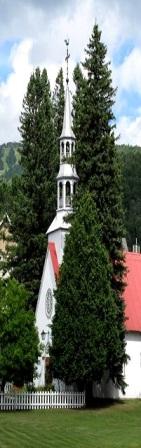 Chapel at the bottom of Mont Tremblant (875m), Province of Quebec, Canada
GOOGLE TRANSLATE LAYOUT
Eleventh Sunday of Ordinary Time (Year C)
First Reading
A reading from the Second Book of Samuel (12:7-10, 13)
Nathan said to David: "Thus says the Lord God of Israel: "I anointed you king of Israel. I rescued you from the hand of Saul. I gave you your lord's house and your lord's wives for your own. I gave you the house of Israel and of Judah. And if this were not enough, I could count up for you still more. Why have you spurned the Lord and done evil in his sight? You have cut down Uriah the Hittite with the sword; you took his wife as your own, and him you killed with the sword of the Ammonites. Now, therefore, the sword shall never depart from your house, because you have despised me and have taken the wife of Uriah to be your wife."" Then David said to Nathan, "I have sinned against the Lord." Nathan answered David: "The Lord on his part has forgiven your sin: you shall not die."
(P) The word of the Lord.(R) Thanks be to God.
Responsorial Psalm
Psalms of David (32:1-2, 5, 7, 11)
(R) Lord, forgive the wrong I have done.
Blessed is the one whose fault is taken away, whose sin is covered. Blessed the man to whom the Lord imputes no guilt, in whose spirit there is no guile. (R)
I acknowledged my sin to you, my guilt I covered not. I said, "I confess my faults to the Lord," and you took away the guilt of my sin. (R)
You are my shelter; from distress you will preserve me; with glad cries of freedom you will ring me round. (R)
Be glad in the Lord and rejoice, you just; exult, all you upright of heart. (R)
Second Reading
A reading from the Letter of Saint Paul to the Galatians (2:16, 19-20)
Brothers and sisters: We know that a person is not justified by works of the law but through faith in Jesus Christ. We have believed in Christ Jesus that we may be justified by faith in Christ and not by works of the law, because by works of the law no one will be justified.
For through the law I died to the law, that I might live for God.
I have been crucified with Christ; yet I live, no longer I, but Christ lives in me; insofar as I now live in the flesh, I live by faith in the Son of God who has loved me and given himself up for me. I do not nullify the grace of God; for if justification comes through the law, then Christ died for nothing.
(P) The word of the Lord.(R) Thanks be to God.
Gospel
A reading from the holy Gospel according to Luke (7:35-50)
A Pharisee invited Jesus to dine with him, and he entered the Pharisee's house and reclined at table. Now there was a sinful woman in the city who learned that he was at table in the house of the Pharisee. Bringing an alabaster flask of ointment, she stood behind him at his feet weeping and began to bathe his feet with her tears. Then she wiped them with her hair, kissed them, and anointed them with the ointment.
When the Pharisee who had invited him saw this he said to himself, "If this man were a prophet, he would know who and what sort of woman this is who is touching him, that she is a sinner." Jesus said to him in reply, "Simon, I have something to say to you." "Tell me, teacher," he said, "Two people were in debt to a certain creditor; one owed five hundred days' wages and the other owed fifty. Since they were unable to repay the debt, he forgave it for both. Which of them will love him more?" Simon said in reply, "The one I suppose, whose larger debt was forgiven." He said to him, "You have judged rightly."
Then he turned to the woman and said to Simon, "Do you see this woman? When I entered your house, you did not give me water for my feet, but she has bathed them with her tears and wiped them with her hair. You did not give me a kiss, but she has not ceased kissing my feet since the time I entered. You did not anoint my head with oil, but she anointed my feet with ointment. So I tell you, her many sins have been forgiven because she has shown great love. But the one to whom little is forgiven, loves little." He said to her, "Your sins are forgiven." The others at table said to themselves, "Who is this who even forgives sins?" But he said to the woman, "Your faith has saved you; go in peace."
(P) The Gospel of the Lord.(R) Praise to you, Lord Jesus Christ.
Homily
One day a devout Christian parked his car in a no-parking zone because he was short of time and couldn't find a parking lot with a meter. So he put a note under the windshield wiper that read: "I have circled the area ten times. If I don't park here, I'll miss my appointment. Forgive me for my trespasses." When he returned, he found a citation from a police officer along with his note. "I've patrolled the area for ten months. If I don't give you a ticket, I'll lose my job. Lead me not into temptation."
Many biblical figures and saints are often seen as exemplary people whom we can follow or whose virtues we can imitate. However, we are reminded that these people are not born with special gifts and privileges. They are not born holy but made holy. They are weak, imperfect, sinful and utterly human as we are. They are ordinary people who love God and His teaching. They are people who humbly pray not only for the forgiveness of trespasses but also the necessary grace to resist the temptations of the world, the flesh and the devil so as to attain a high degree of holiness. David, about whom we read in today's first reading, is one of the most admired and powerful biblical figures. We read about his spiritual greatness and the outpouring of his soul in the book of Psalms of which many are traditionally attributed to David.
Who is David? The scriptures tell us that David was the youngest of eight sons in his family and a shepherd boy. He was a gifted musician and brave young man. His defining moment was when he fought and killed the giant soldier Goliath with a slingshot. Following this victory, David became popular with the Israelites and became a friend of King Saul. Saul eventually grew jealous of David and tried to kill him several times. David escaped from Saul and lived as a fugitive for about fifteen years until the prophet Samuel sent by God anointed David as king over Israel.
In today's reading, 2 Samuel (12:7-13), the Lord sends the prophet Nathan to confront King David about his sin. The prophet says, "Why have you spurned the Lord and done evil in his sight?
What was King David's sin? The prophet says, "You have cut down Uriah the Hittite with the sword; you took his wife as your own, and him you killed with the sword of the Ammonites." Perhaps many of us do not understand what the prophet is talking about. Chapter 11 of the book elaborates the story. One time David sent his army out to fight his enemies, the Ammonites but he himself stayed behind in Jerusalem. One evening as he was strolling on the terrace of his home, he looked down and saw a beautiful woman called Bathsheba bathing. She was the wife of a soldier named Uriah who was at the battle. David taking full advantage of his position as king, slept with Bathsheba. Sometime later when he heard from Bathsheba that she was pregnant with his child he became confused and afraid. He arranged for Uriah to return home and rewarded him with gifts and encouraged him to spend the night with his wife so that later everyone would believe that the baby was Uriah's and not his. But Uriah, who was a strict observant of the law, in a show of solidarity with his friends, who abstained from sexual relations during battle, refused to sleep with his wife despite David's persuasion. So David sent Uriah to fight another battle but with a message, carried by Uriah himself, to Joab, the commander of the troops to have him killed. After Uriah's death, David made Bathsheba one of his wives. God could not tolerate David's sinfulness anymore. He sent his prophet Nathan to rebuke David for the string of sins he committed - lust, adultery, deception and murder. Being ashamed of his sinful conduct David said, "I have sinned against the Lord." Nathan replied, "The Lord on his part has forgiven you your sins; you shall not die." However, God's judgment, as prophesied by Nathan, befell David and his family. First, David and Bathsheba had a child who became sick and died, and later three of his other sons died violent deaths. Eventually as God had promised, the fourth son Solomon finally became king of Israel.
There are many lessons to be learned and applied to our lives:
- Before reproving David for his sins, the prophet lists some of the things that David had received from the Lord, including how God had delivered him from the hand of Saul and all the property and women he had inherited as king. It was to remind him that in spite of God's faithfulness he went on to commit sin after sin. When we are being tempted to commit a sin let us intentionally remember every act of kindness, goodness and faithfulness of the Lord. I believe even a short pause will lead us to overcome the temptation.
- As Christians we are not immune to sin. Despite our best efforts and prayers each of us may sin. We're just as sinful as the unbelievers. Sin is part of our human nature. But God intends to remove it from all of us through the sacrifice of his Son Jesus Christ. Let us therefore continue to walk with determination on the path of holiness so that where our Lord Jesus and all the saints have gone, we too may follow.
- The scriptures make us become aware of our sins. Let us not try to hide or rationalize them or act as if sin does not exist. Let us not allow our pride, arrogance, haughtiness and self-will to prevent us from believing the scriptures and stop us from asking for forgiveness and grace to avoid sin. We are unable to resist temptations without God's grace.
- There is no sin that transcends God's grace. God rejoices over our conversion regardless of the type of sin. Let us not focus on the seriousness of our sins but rather on the greatness of our Lord Jesus and the depth of His love for each of us. Let us therefore courageously confront and confess all our sins.
- God does not condemn us for our sinfulness but for our refusal to repent and change our ways. He is merciful, kind and patient. He is always waiting for our return. Jesus says, "I have come so that you may have life and have it to the full", John (10:10). Like David and all the saints let us also find comfort in the truth that God loves us with a love that will never let us die but live. Let us therefore surrender ourselves to him so that He will make our lives richer and fuller for Him.
God Bless You!
Content Options
 share this homily via:

